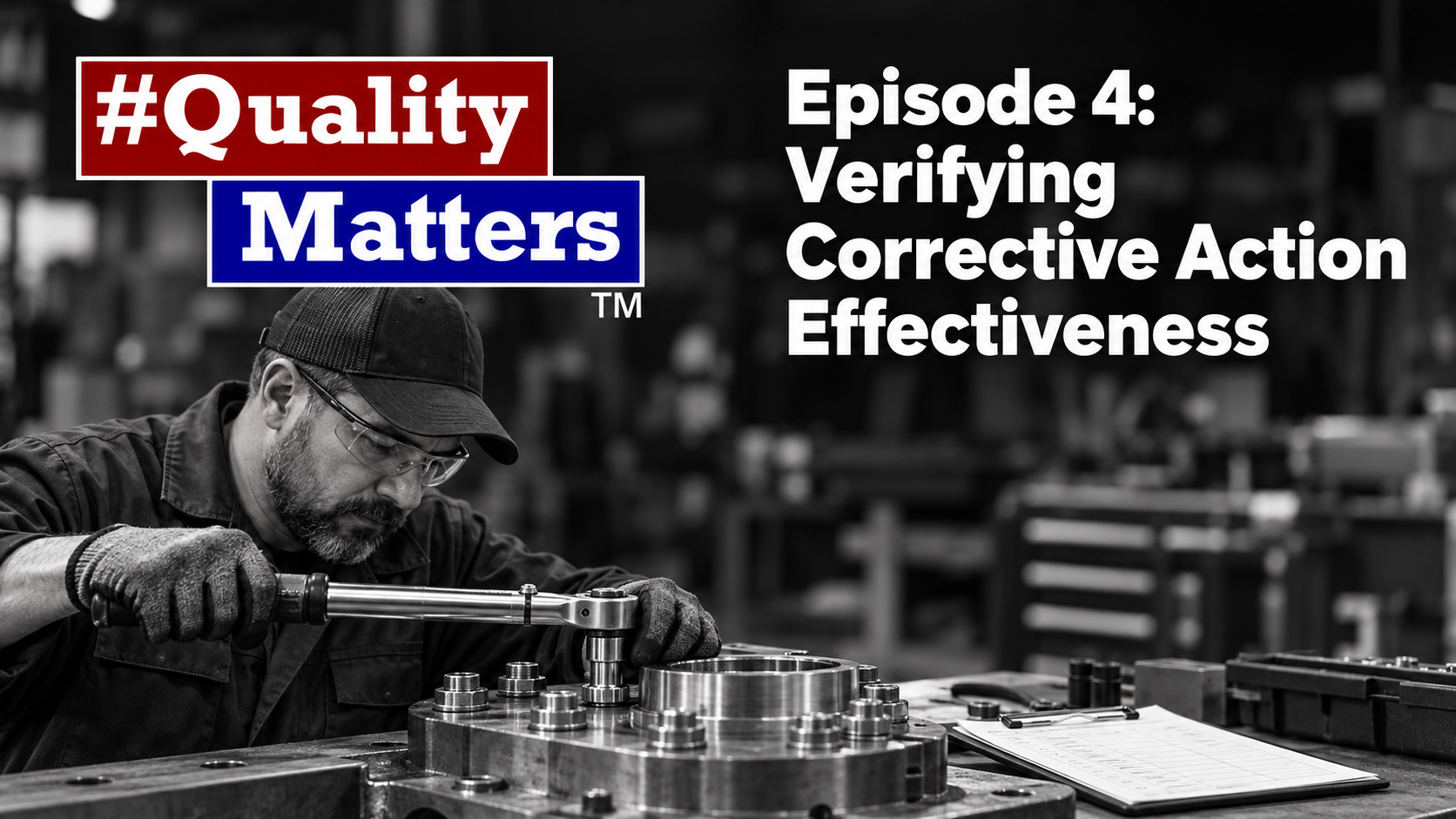
Episode 4: Verifying Corrective Action Effectiveness #QualityMatters2.0
A revised procedure can show that a team completed a corrective action, but it cannot prove the problem will stay fixed. In Episode 4, Kyle Chambers and Caleb Adcock examine that gap through corrective action effectiveness. Revisiting the Rivian recall discussed in the previous episode, they consider what should happen after a manufacturer changes an automated check. The central question is whether that change addresses the cause and whether similar equipment could share the same weakness.
That broader review starts with root cause analysis that looks beyond the person who made the mistake. Kyle and Caleb caution against treating retraining as the automatic answer or creating a separate exception for every customer problem. Instead, they recommend examining the process and reviewing similar equipment or programs for the same failure mode. Someone outside the project can help challenge assumptions that the people closest to the work may overlook.
Once the team implements a change, verification of effectiveness requires evidence from subsequent work. The hosts describe keeping corrective actions in a complete-pending-verification status while comparable jobs pass through the revised process. Smaller shops may review several relevant jobs, while larger operations may have enough data to compare defect rates. An internal or external audit can also provide an independent review, particularly when the change concerns training or management processes.
Those follow-up checks extend to the inspections themselves, including automated checks. Observing an inspector and independently checking the same work can reveal gaps that paperwork misses. Kyle and Caleb recommend applying the same scrutiny to automation rather than assuming repeatability guarantees a reliable result. Their approach to corrective action effectiveness is to implement the fix promptly, then allow evidence to support closure.
Podcast: Play in new window | Download